
Supreme Court Temporarily Blocks Halting Trump's White House Ballroom Construction
National Sentiment
Divided
What’s Happening at a Glance
- Supreme Court grants emergency stay allowing continued construction of Trump's $400M White House ballroom
- Lower courts ruled Trump lacks legal authority to build without congressional approval
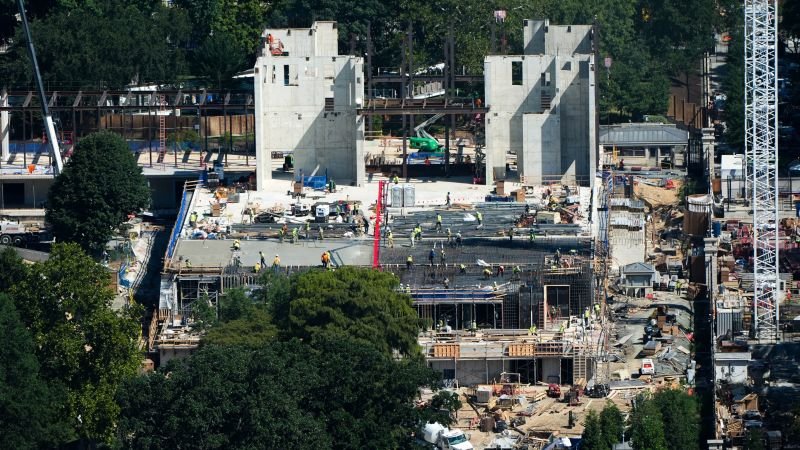
- Project 65% complete, includes underground bunker and secure facilities
- Historic preservation group sued to halt construction, citing damage to White House's architectural integrity
- Justices will review case further; no immediate ruling on project legality
Summary
The U.S. Supreme Court has temporarily blocked enforcement of a lower court order that would have halted construction of President Donald Trump's $400 million White House ballroom project. The administrative stay, issued by Chief Justice John Roberts, gives the conservative justices additional time to consider the administration's formal request to continue work while litigation proceeds. The move freezes a ruling from the U.S. Court of Appeals for the D.C. Circuit, which unanimously upheld a district judge's order requiring the administration to pause above-ground construction. The nonprofit National Trust for Historic Preservation sued in December 2025, arguing that Trump is illegally reshaping the White House – specifically the demolished East Wing – without congressional approval. Lower courts have consistently agreed, stating that presidents serve as temporary tenants and cannot fundamentally alter the historic structure without legislative authorization. The Trump administration argues the facility is a national security necessity, citing recent assassination attempts and threats against the president.
Why It Matters
This case tests the boundaries of executive power and presidential authority over the White House complex. While presidents have historically made modifications to the Executive Mansion, major structural changes typically require congressional approval under the 1933 White House Preservation Act and subsequent legislation. Precedent shows that even renovation projects of significant scope – such as those under Theodore Roosevelt and Franklin D. Roosevelt – were coordinated with Congress. The Trump administration's assertion that the ballroom is a "military center" raises unprecedented questions about civilian-military integration within the White House grounds. Legal scholars note that if the Supreme Court ultimately permits the project to proceed without congressional consent, it could establish a precedent allowing future presidents to undertake large-scale modifications independently. The case also highlights growing tensions between historic preservation efforts and modern security needs in federal architecture.
National Impact
- Government: Reinforces or limits presidential autonomy over White House modifications; sets precedent for executive authority
- Citizen: Taxpayer funding concerns amid rising costs from $200M to $400M; impact on White House tours and public access uncertain
- Business: Construction contracts awarded without competitive bidding raise procurement questions; local workforce affected
- Community: White House tenants and staff impacted by ongoing construction; nearby residents affected by noise and traffic
- Institutional: Tests independence of federal judiciary vs. executive branch; raises questions about accountability in federal spending
Impact on People
- Households: Increased federal spending on controversial project amid inflation and economic concerns
- Communities: Security perimeter expanded around White House; potential disruption to surrounding neighborhoods
- Public services: National Park Service oversight of White House tours complicated by active construction zones
- Education: Student groups visiting Capitol may face schedule disruptions due to construction activity
- Healthcare: Emergency response protocols adjusted near White House campus during construction phases
- Public safety: Enhanced security measures implemented; new protocols for first responders during events
Key Organizations & Institutions
- Government agencies: Supreme Court of the United States, Department of Justice, White House Military Office
- Institutions: White House, U.S. Court of Appeals for the D.C. Circuit, National Trust for Historic Preservation
- Organizations: Federal Reserve, General Services Administration, U.S. Secret Service
- Officials: President Donald Trump, Chief Justice John Roberts, Solicitor General D. John Sauer
- Courts: U.S. District Court for the District of Columbia, U.S. Supreme Court
- Public bodies: Congress (pending legislative action), D.C. City Council
Future Outlook
The Supreme Court is expected to refer the case to all nine justices for full briefing and deliberation. Arguments could be scheduled for fall 2026, with a final ruling anticipated by spring 2027. Meanwhile, construction continues at an accelerated pace, with reports indicating use of specialized concrete that would make demolition extremely difficult – a tactic preservationists argue constitutes irreversible damage. If the Court lifts the lower court injunction permanently, the project could be completed before the end of Trump's term. However, if it sides with historic preservationists, the administration would face pressure to halt construction immediately and potentially restore portions of the East Wing. Congressional involvement remains possible regardless of the Court's decision, particularly regarding funding oversight and future architectural standards for the White House complex. The case may also influence broader debates about presidential conduct and the treatment of federal properties during transitions of power.