
Etched's Agentic Chips Are the Silicon Valley Circus Act You Didn't Know You Needed
Business Sentiment
Disruptive
What’s Happening at a Glance
- AI chip startup Etched claims breakthrough with proprietary transformer-based inference systems
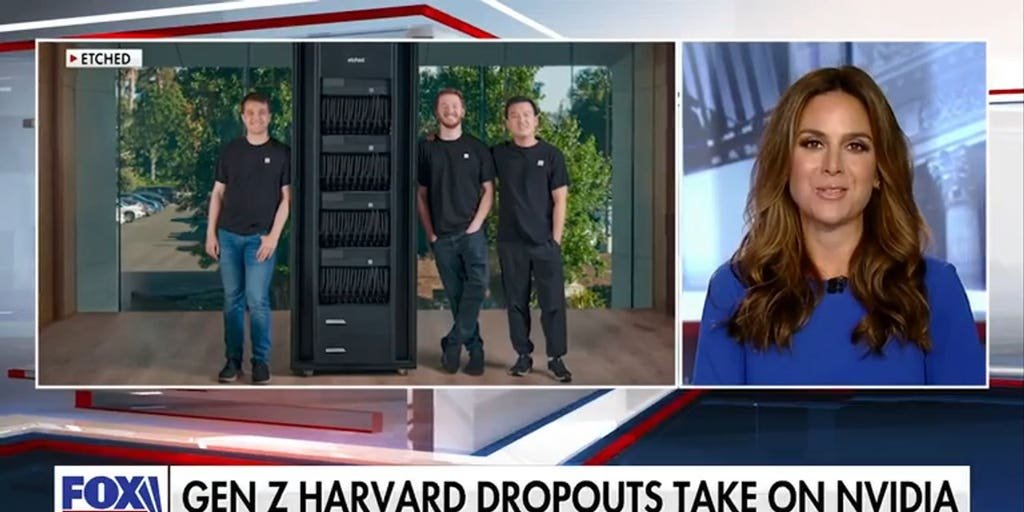
- CEO Gavin Uberti showcased company success on 'Maria Bartiromo's Wall Street'
- Company recruiting top silicon Valley talent to build specialized AI hardware
- Move represents shift toward agentic AI processing rather than traditional GPU clusters
Summary
AI chip startup Etched is making waves in Silicon Valley by recruiting elite talent to develop specialized transformer-based inference systems. The company's CEO Gavin Uberti recently highlighted the firm's progress during an appearance on 'Maria Bartiromo's Wall Street,' positioning Etched as a challenger to established players like NVIDIA. Unlike conventional approaches that rely on GPU clusters for AI processing, Etched appears to be focusing on custom silicon designed specifically for transformer architectures. The company's strategy revolves around building hardware optimized for agentic AI workloads, which require different computational characteristics than training-focused systems.
The broader narrative suggests Etched is betting on a future where large language models and other transformer-based AI systems require specialized inference hardware rather than general-purpose GPUs. This approach could potentially offer better performance-per-watt and lower latency for specific AI applications, though the company faces significant competition from well-funded incumbents who have years of head start in the AI chip market.
The recruitment of top talent indicates confidence that Etched can attract experienced engineers and researchers from established semiconductor companies, suggesting either attractive compensation packages or compelling technical vision. However, the company operates in an intensely competitive space where even well-funded startups often struggle to achieve meaningful market differentiation.
Why This Is Happening
The AI hardware market has become increasingly crowded as demand for efficient inference processing outpaces the capabilities of traditional GPU-centric approaches. Transformer models, which power much of today's generative AI, have different computational requirements than earlier neural network architectures, creating opportunity for specialized hardware. Established players like NVIDIA have dominated this space through CUDA ecosystem lock-in and years of optimization, but their solutions often consume significant power and generate substantial heat, driving interest in alternatives. Venture capital funding for AI infrastructure continues flowing, creating fertile ground for startups to assemble top talent and develop novel approaches to hardware-accelerated AI workloads.
Key Business Impact
- Corporate impact: Early-mover advantage in agentic AI inference market if technical claims hold
- Industry impact: Potential disruption of GPU monopoly in AI inference processing
- Jobs/workforce: Creation of specialized roles in transformer-optimized chip design
- Consumer market: Possible improvement in AI service performance and pricing
- Investor implications: High-risk, high-reward play in infrastructure for next-generation AI
- Economic ripple effects: Competition could drive down costs and accelerate AI adoption
Impact on People
- Employment/jobs: Premium positions for chip engineers and AI hardware specialists
- Consumer pricing: Potential cost reductions in AI-powered services over time
- Small businesses: Access to more affordable, specialized AI processing options
- Investments/retirement: Exposure to frontier AI infrastructure through venture networks
- Services/products: Enhanced performance for AI applications requiring real-time processing
- Daily economic impact: More responsive consumer AI assistants and productivity tools
Affected Industries
- Technology
- Semiconductor
- Artificial Intelligence
- Consumer electronics
- Cloud computing
- Enterprise software
Key Companies
- Etched (primary subject)
- NVIDIA (main competitor)
- Google (TPU development)
- AMD (competitive response)
- Intel (IDM competition)
- Maria Bartiromo's Wall Street (media platform)
Future Outlook
If successful, Etched's approach could catalyze broader industry shift toward transformer-optimized silicon, potentially fragmenting the AI hardware market beyond NVIDIA's dominance. However, the company faces Herculean challenges in securing sufficient funding, attracting talent away from established players, and proving technical advantages at scale. Long-term implications depend on whether agentic AI workloads truly require specialized hardware or if software optimization can bridge performance gaps. The next 12-18 months will be critical for determining whether Etched can translate technical claims into commercial products that attract major enterprise customers and additional funding rounds.