
China's Robot Olympians Crash, Burn, and Still Mint Billionaires as Unitree IPO Soars 460%
Business Sentiment
Mixed
What’s Happening at a Glance
- Unitree Robotics shares surged 460% on Shanghai debut, valuing the humanoid maker at billions despite robots that still crash into walls and catch fire
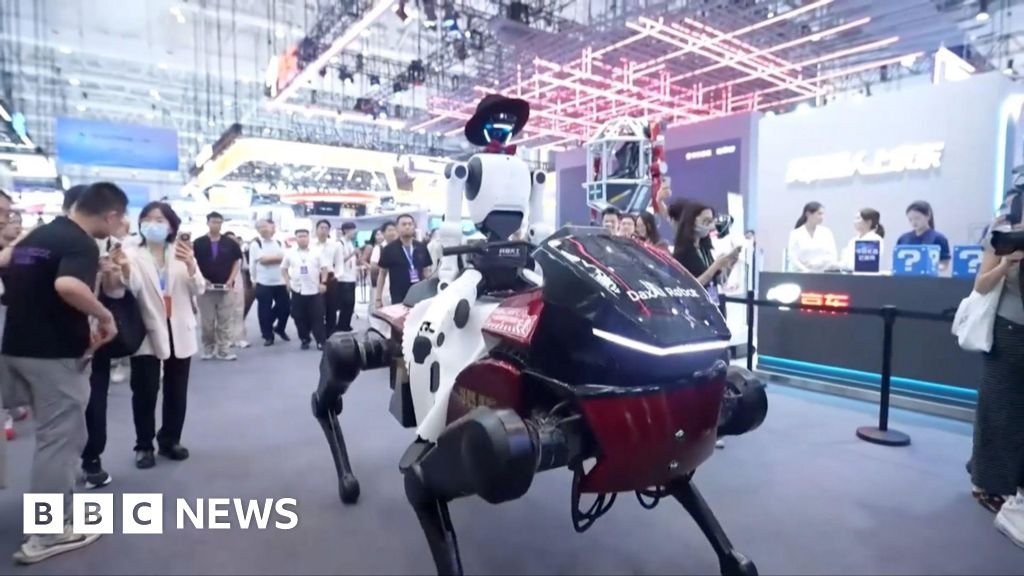
- Beijing's World Humanoid Robot Games showcase 2,000+ machines from 16 nations sprinting, playing soccer, and losing limbs in padded-wall collisions
- Morgan Stanley projects $7.5 trillion humanoid market by 2050; Chinese firms dominate current commercial landscape while US rivals lag in hardware
- FCC restrictions on Chinese "advanced robotic devices" complicate US supply chains even as Silicon Valley investment triples
- Unitree CEO warns industry's "ChatGPT moment" remains a decade away despite record $33.8B global robotics funding in 2025-2026
Summary
China's state-backed robotics push took center stage this week as the 2026 World Robot Conference and Humanoid Robot Games unfolded in Beijing. The five-day spectacle featured over 2,000 robots from 16 countries competing in Olympic-style events – 100-meter sprints, 7-on-7 soccer, tug-of-war, weightlifting, and martial arts – while Unitree Robotics, the sector's Chinese champion, made a explosive stock market debut in Shanghai. Shares soared as much as 629% intraday before closing up 460%, minting instant paper billions for a company whose machines still routinely crash into padded walls, shed limbs mid-race, and occasionally catch fire during competition.
The disconnect between market euphoria and mechanical reality was on vivid display. Chinese state media claimed a robot named "Lightning" beat Usain Bolt's 100-meter world record in testing, yet Saturday's live events revealed robots that lose interest during soccer matches, kick opponents for yellow cards, and require four-man stretcher teams to clear the track. A low-speed tennis match between human and robot ended in human victory. Meanwhile, the broader investment backdrop is staggering: global robotics startups raised $15 billion in 2025 and another $18.8 billion through mid-2026, per Crunchbase, while Elon Musk's $1 trillion Tesla pay package hinges on delivering one million Optimus humanoids.
Underneath the spectacle, a strategic rivalry is hardening. China's humanoid market dominance – led by Unitree and local rivals – rests on manufacturing scale and state support, while US innovation is constrained by hardware shortages and new FCC restrictions blocking cheap Chinese components. Attendance at San Francisco's Actuate robotics conference has tripled in two years as Silicon Valley investors chase the next platform shift, but Unitree's own CEO cautions the industry's breakthrough moment may be ten years out. For now, the robots are performing; the profits are speculative; and the geopolitical walls are rising faster than the machines can climb them.
Why This Is Happening
China's robotics surge stems from a convergence of demographic crisis, industrial policy, and AI ambition. With the world's fastest-aging workforce and shrinking labor pool, Beijing has designated humanoid robots as a strategic priority in its 14th Five-Year Plan and "Made in China 2025" successor initiatives. The World Robot Conference and Games serve as both domestic showcase and international signaling – demonstrating manufacturing depth while attracting global talent and investment. Unitree's IPO timing was deliberately synchronized with the conference opener, maximizing state media coverage and retail investor frenzy in Shanghai's STAR Market.
On the US side, the investment surge reflects fear of missing the next compute-platform wave after AI software. Venture capital has flooded into embodiment – giving AI physical form – but American startups face a hardware gap: they design in Silicon Valley but rely on Chinese supply chains for actuators, sensors, and precision components. The FCC's new restrictions on "advanced robotic devices" from foreign adversaries, implemented last month, explicitly target this dependency, forcing costly domestic reshoring or alternative sourcing. Meanwhile, Tesla's Optimus program – backed by Musk's unprecedented compensation package – has become the de facto US flagbearer, though mass production remains years out.
Morgan Stanley's $7.5 trillion by 2050 projection assumes humanoids eventually penetrate logistics, manufacturing, elder care, and domestic service – markets measured in hundreds of millions of units. But the path requires solving three hard problems simultaneously: robust real-world AI (not demo AI), reliable low-cost hardware at scale, and sustainable unit economics. China leads on hardware manufacturing and state-funded deployment pilots; the US leads on foundational AI models. The Games are essentially a public benchmarking exercise for a race where both sides are still tying their shoes.
Key Business Impact
- Corporate: Unitree's 460% debut pop creates massive paper wealth but sets extreme execution expectations; Chinese peers (Fourier, UBTECH, Xiaomi CyberOne) gain valuation tailwinds and talent attraction
- Industry: Record $33.8B global funding in 18 months signals peak hype cycle; expect consolidation, down-rounds, and pivot-to-software as hardware bottlenecks persist
- Jobs/workforce: Near-term displacement minimal – robots still fail basic reliability tests; long-term threat shifts from blue-collar repetitive tasks to semi-structured environments (warehouses, hospitals, retail)
- Consumer market: No meaningful consumer products yet; earliest adopters will be industrial/enterprise (auto lines, logistics hubs) with household deployment post-2030 per most roadmaps
- Investor implications: High speculative premium priced into pure-play robotics names; diversified exposure via automation ETFs, component suppliers (harmonic drives, LiDAR, rare earths) safer than single-stock bets
- Economic ripple effects: US-China tech decoupling extends to robotics hardware; FCC rules accelerate "friend-shoring" but raise BOM costs 15-30% for US integrators; China's manufacturing moat deepens
Impact on People
- Employment/jobs: Warehouse and factory workers face gradual augmentation not replacement; new roles emerging in robot fleet management, teleoperation, and sim-to-real training data labeling
- Consumer pricing: No near-term price impact; eventual humanoid labor substitution could reduce service costs (elder care, last-mile delivery) but timeline uncertain
- Small businesses: High-cost barrier excludes SMBs from early adoption; robotics-as-a-service models may democratize access mid-decade if unit economics improve
- Investments/retirement: Thematic robotics ETFs seeing inflows; retail investors chasing Unitree-like momentum should note lock-up expirations and revenue-concentration risks
- Services/products: Healthcare and elder care in Japan/China first testbeds for real deployment; US regulatory (FDA, OSHA) and liability frameworks unprepared for autonomous humanoids
- Daily economic impact: Invisible today; the Games are theater – real impact arrives when robots reliably unload trucks, assemble parts, or assist nurses without human babysitters
Affected Industries
- Technology (AI/robotics convergence)
- Manufacturing (industrial automation, automotive)
- Logistics & Warehousing
- Healthcare & Elder Care
- Semiconductors & Components (actuators, sensors, edge compute)
- Defense & Dual-Use
- Retail & Last-Mile Delivery
- Education & Research
Key Companies
- Unitree Robotics (China, newly public, market leader)
- Tesla / Optimus (US, best-funded, mass-production ambition)
- Fourier Intelligence, UBTECH, Xiaomi (China, commercial deployments)
- Agility Robotics, Figure AI, Apptronik, 1X (US, well-capitalized startups)
- NVIDIA (simulation/training stack via Isaac Sim, GR00T)
- Harmonic Drive Systems, Maxon, Teledyne (critical component suppliers)
- Morgan Stanley, Crunchbase (market sizing/data)
- FCC, US Commerce Dept (regulatory gatekeepers)
- Chinese MIIT, SASAC (industrial policy architects)
Future Outlook
The next 18-24 months will separate demo-ware from deployable systems. Watch for: (1) First credible >1,000 unit commercial fleet deployment in structured environment (auto plant, fulfillment center); (2) US component supply chain independence milestones – domestic actuator/sensor production at scale; (3) China's export controls retaliation on rare earths or precision parts critical to Western robots; (4) AI breakthrough enabling generalizable manipulation (sim-to-real transfer, few-shot learning); (5) Regulatory frameworks for liability, safety certification, and public space operation. Unitree's CEO's "decade to ChatGPT moment" may be optimistic – or pessimistic if foundation models crack embodiment faster than hardware scales. Either way, the Games are the opening ceremony; the marathon starts when the cameras leave.