
Pixel Watch 5 Gets AI Watch Faces and Health Guardian – Because Who Needs Working Features When You Have Promises?
Industry Sentiment
Mixed
What’s Happening at a Glance
- Pixel Watch 5 launches at $400, $50 more than its predecessor, with modest hardware bumps (Snapdragon W5 Gen 2, 3GB RAM, 64GB storage).
- New AI watch face generator lets users create faces via voice commands using Gemini, though limited to preset layouts.
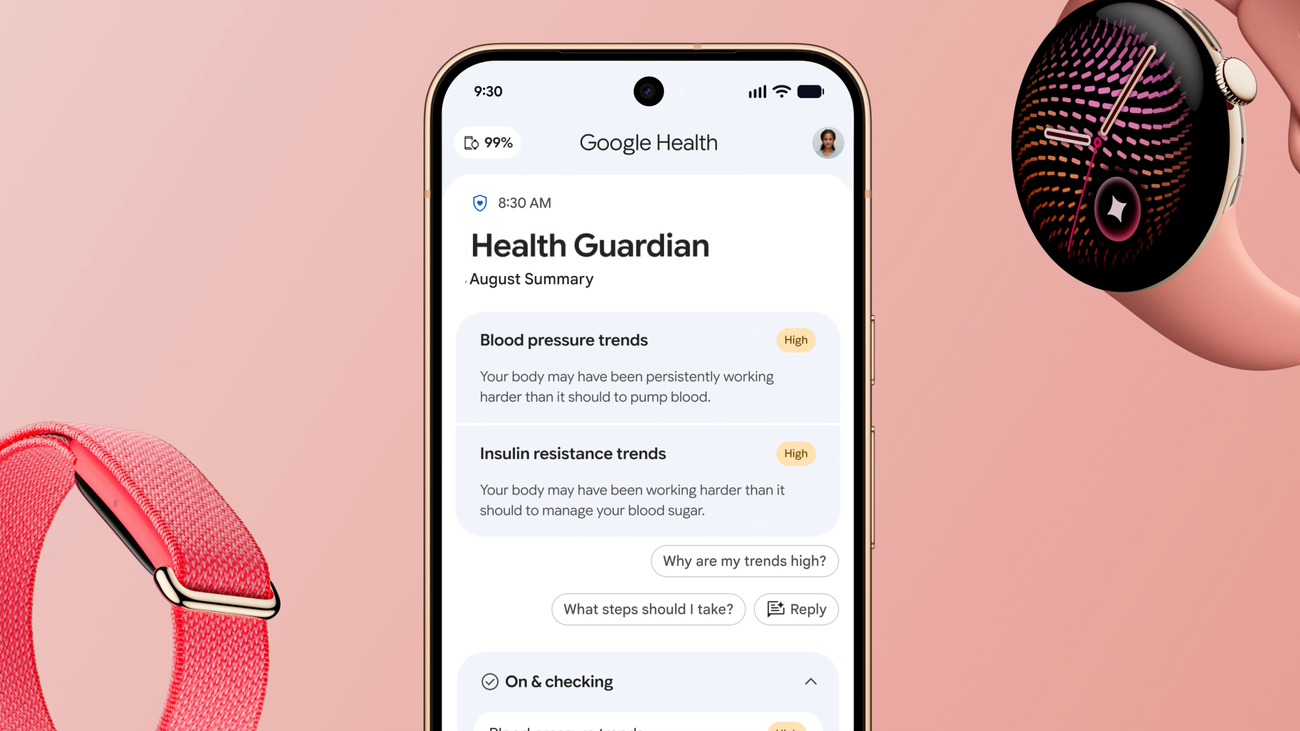
- Health Guardian suite adds background tracking of insulin resistance, blood pressure trends, sleep breathing quality, and emergency respiratory events, requiring a Google Health Premium subscription.
- Many advertised features (Offline Gemini, Workout Builder, GPS accuracy improvements) are either delayed or only partially functional at launch.
- Battery life remains similar to Pixel Watch 4 (~24‑28 hours), with faster charging (~45 min to full).
Summary
Google’s latest Pixel Watch 5 arrives with a familiar design but a suite of AI‑driven enhancements aimed at differentiating Wear OS from Apple and Samsung rivals. The headline feature is a Gemini‑powered watch face creator that lets wearers describe a desired look by voice and get a generated face in seconds, though the output is confined to a few layout templates. On the health front, Google introduces Health Guardian, a set of passive sensors that monitor insulin resistance, blood pressure trends, sleep breathing quality, and potential respiratory emergencies, surfacing insights in the Google Health app and nudging users via a Health Coach – features that lock behind a $10‑per‑month Health Premium subscription.
Hardware upgrades are incremental: a slightly newer Qualcomm chip, extra RAM and storage, and a marginally larger battery that does not translate into noticeably longer endurance. While Google promises improved GPS accuracy through cloud‑based post‑processing and better heart‑rate tracking, many of the touted software innovations – such as Offline Gemini for disconnected use and the Workout Builder for guided strength training – were not fully ready during testing, leaving early adopters to grapple with unfinished features. The watch also retains Wear OS 7’s tighter integration with Pixel phones for notifications, Maps, Wallet, and live updates, positioning the Pixel ecosystem as a seamless, if pricey, extension of the smartphone experience.
Overall, the Pixel Watch 5 feels more like a platform for future AI and health experiments than a finished product. Google is betting that generative watch faces and proactive health monitoring will entice users to subscribe to Health Premium and stay loyal to its ecosystem, even as the $50 price increase invites direct comparisons to the still‑capable Pixel Watch 4 and competing devices from Apple and Samsung.
Why This Is Happening
Google is leveraging its Gemini AI foundation to add distinctive software features to Wear OS, attempting to break out of the shadow of Apple Watch and Samsung Galaxy Watch. Health tracking has become a key battleground, and by introducing AI‑analyzed metrics like insulin resistance and blood pressure trends, Google aims to offer proactive wellness insights that go beyond basic heart‑rate counting. The premium subscription model for Health Guardian mirrors the company’s broader push to monetize services across hardware, while tighter integration with Pixel phones encourages ecosystem lock‑in. Incremental hardware bumps (new chip, more memory) enable on‑device AI workloads like offline Gemini, reflecting a shift toward hybrid cloud‑edge processing for responsiveness and privacy.
Key Industry Impact
- Big tech impact: Google reinforces Wear OS as a testbed for Gemini AI and health AI, challenging Apple’s health‑centric narrative.
- Startup ecosystem: Emerging AI‑health wearables face increased pressure from Google’s integrated sensor‑model approach.
- Developers/engineering: New APIs for voice‑driven watch face creation and Gemini access open avenues for custom complications and offline AI tasks.
- Consumer technology: Users gain more personalized watch faces and passive health alerts, though reliance on premium subscriptions may limit adoption.
- Regulatory implications: Health Guardian metrics are marketed for wellness only, avoiding FDA clearance for now, but could attract scrutiny if claims expand.
- Business competition: Apple and Samsung must respond with comparable AI features or risk losing health‑focused users to Google’s evolving platform.
Impact on People
- Consumer experience: Fun, conversational watch face creation adds novelty; health insights offer proactive nudges but require subscription and app review.
- Privacy/data usage: Continuous background sensing of metabolic and respiratory data raises concerns about data storage and Google’s use patterns.
- Employment/jobs: Minimal direct impact; potential growth in AI health model training and wearable‑app development roles.
- Pricing/costs: $50 higher entry price plus $10/month for full health features increases total cost of ownership.
- Accessibility: Health Guardian features are not medical devices and may be less reliable for users with skin tones, tattoos, or certain medical conditions.
- Daily life: Users may receive early warnings about metabolic or respiratory trends, encouraging lifestyle adjustments, but must still verify with professional devices.
Key Technologies
- AI: Gemini generative models for watch faces; on‑device health‑trend models trained on millions of sensor data points.
- Cloud: Post‑processing of GPS data; Health Guardian analytics stored and summarized in Google Health backend.
- Hardware: Qualcomm Snapdragon W5 Gen 2 SoC, 3GB RAM, 64GB storage, slightly larger battery, Gorilla Glass 5.
- Software: Wear OS 7, Google Health app, Health Coach, Offline Gemini, Workout Builder, Live Updates.
- Cybersecurity: Data encrypted in transit and at rest; user consent required for health data collection; premium subscription gating.
- Platforms: Pixel Watch 5, Fitbit devices (future Health Guardian rollout), Android smartphones.
- Infrastructure: Google’s cloud AI infrastructure for model training and inference; edge processing on watch for Gemini voice commands.
Key Companies
Future Outlook
Expect Google to refine the AI watch face generator with additional layouts (including analog styles) and expand Health Guardian’s metric set once clinical validation and potential FDA clearance progress. Offline Gemini and Workout Builder should become more reliable as software matures, possibly driving greater adoption of on‑device AI wearables. If premium uptake is modest, Google may bundle some health features into the base offering or adjust pricing to compete more aggressively. The overall trajectory points toward a future where smartwatches act as continuous, AI‑powered health coaches, but success will hinge on delivering reliable, actionable insights without overpromising.